Deconstructing Narrative - Antonio Canova’s Perseus Triumphant
• Roopesh Singh
Opening: The Abstract
Art history has long used logic to interpret Antonio Canova’s Perseus Triumphant (1800–1801), which sadly has sidelined progressive critics who argue that the foundational trauma of Medusa has been systematically erased from the narrative. For over two centuries, the consensus has claimed that the sculpture represents the pinnacle of Neoclassical purity, a flawless execution of contrapposto, and a noble homage to the Apollo Belvedere. When progressive critics challenge the work on moral or narrative grounds, their arguments get rejected as subjective, modern emotional projections that fail to comprehend the formal geometry of the marble.
In this article, an alternative perspective will be presented to examine the sculpture from the inside out by establishing a structural argument within the physical geometry of the stone. By analyzing the structure and physical geometry recorded by Canova’s chisel, we’ll build an argument to bring to surface some facts recorded during its formation which might have been overlooked by art history. One principle will be our tool to deconstruct narrative and facts; that the intent and the impact carry their own meanings, and they may sometimes coincide, and other times they may diverge. While intent belongs to the creator, impact belongs to the material. When these two forces fracture, the narrative begins to wobble. Most of the time when meanings diverge, it is indicative of the fact that the undercurrents of meaning are not ready to merge, which is why the narrative keeps wobbling. The artist may not have intended this, but the article soul is based on the impact of its final formation and the wobbling effect observed in narration.
The sculpture is not an intentional, politically conscious subversion by the artist; rather, it is a structural blueprint of unresolved tension captured by the relentless honesty of material realism. Canova, bound by his dedication to anatomical accuracy and classical lineage, attempts to carve an unburdened hero, but the physical laws of the medium, the essence of material truth, challenges the narrative, and the wobbling resurfaces once more for reconciliation.
The article documents the evolutionary point where competing meaning becomes increasingly difficult to reconcile. As time progresses, the mask slips, and the raw, uncontainable truth of the vulnerability of mortality forces its way back to the surface, leaving the narrative in stone to be reinterpreted, possibly moving towards the merging of meanings. The presence of the wobble effect is testimony to the divergence of meaning, and truth’s inherent essence to merge and collapse the wobble effect.
Heritage of Injustice: The Wobble Effect
The historical lineage of the Medusa myth reveals that the emergence of truth is not an accident of modern reinterpretation, but a slow, gradual understanding of the history. Across three distinct eras, the dominant narrative gradually is challenged, and the baseline reality of the impact progressively forces its way to the surface.
[THE HISTORICAL TRAJECTORY OF THE SLIPPING MASK]

   ERA:          ANCIENT GREEK             ROMAN (OVIDIAN)              CANOVA'S NEOCLASSICAL
   STRATEGY:     Complete Demonization     Emergence of split          The Final Contradiction

   MASK:         [Total Grotesque Mask] -> [Splits: Crown vs Face]  ->  [MASK SLIPS FURTHER]
                         |                         |                            |
   TRUTH:        Fully Buried              Trauma Exposed              vulnerability Restored in Stone
Act I: The Ancient Primordiality (The Absolute Mask)
In the earliest Greek mythology, recorded by Hesiod and materialized in archaic art, the narrative is in complete control. Medusa is depicted not as a tragic mortal Gorgon, but as a primordial monster, a grotesque entity with tusks, scales, and a petrifying visage. In this ancient layer, no room for an investigation of cause, trauma, or vulnerability is left, and her monstrosity is treated as an objective, natural fact. The mask is total. The erasure of her humanity is absolute, establishing a baseline where a narrative completely demonizes its target to make her destruction unquestionable.
Act II: The Ovidian Fracture (The Split Mask)
The first fracture in the cover up occurs during the Roman era, when the poet Ovid breaks the monstrous baseline. Ovid introduces a competing narrative that significantly alters the moral structure of the myth. In his account, Medusa was originally a mortal priestess of striking beauty whose mere existence allures, and her trauma occurred inside the temple of Minerva (Athena), the goddess of wisdom and strategic justice, at the hands of Neptune (Poseidon). The choice of Athena, the goddess of wisdom, by Ovid is telling tale. Ovid’s deliberate placement of this trauma within the temple of Minerva (Athena), serves as the initial historical rupture where the raw fact of Medusa’s vulnerability surfaces to challenge ancient narrative. The myth introduces a devastating systemic failure where narrative turns against the vulnarable Medusa, criminalizing her trauma by transforming her hair into snakes. Here, Ovid forces a critical split in the narrative architecture. He separates the aggressive, narrative imposed mask of the snakes from the traumatized mortal woman beneath it. Here, Ovid introduces a framework in which Medusa’s monstrosity can be understood as inseparable from a preceding narrative of suffering.
Act III: The Neoclassical Collision (The Mask Slips Further)
By the time the myth materializes in Canova’s studio, the surviving essence of Medusa’s vulnerability has grown too heavy to be contained by the previous narrative. Canova does not act as a conscious political whistle blower; rather, his subconscious, rigorous commitment to material realism forces a radical aesthetic shift. In pursuing anatomical truth, he restores her human beauty and carves her face with undeniable distress. By stripping away the medieval and archaic caricatures of Medusa, the physical execution of the marble causes the earlier demonization to collide violently with the undercurrent essence of vulnerability.
This material restoration creates a narrative contradiction that escapes the sculptor’s ideological intent. The sculpture presents a hero acting as an agent of absolute justice, yet he is executing a figure (Medusa) whose face is a portrait of vulnerable distressed mortal. The impact of Medusa’s distressed imagery creates a contradiction. By freezing the moment just after the blade has struck, the sculpture captures the precise imagery which challenges the entire hisorical account of Persues Medusa saga. The mask slips futher, forcing the viewer to question the very delivery of justice itself.
Frequently, some narration retreat from this material violence into allegorical abstraction, asserting that the figures are merely symbolic archetypes representing Mind (Logos) triumphing over primordial Passion (Pathos). This allegorical framework provides a useful model for understanding how abstract concepts can mediate emotional realities. If we accept this allegory, the sculpture ceases to be a monument of enlightenment and becomes a literal blueprint for the study of prioritization of conceptual categories over immediate emotional experience. Furthermore, this allegorical reading requires the viewer to abstract away from the physical reality of the work, whereas a material analysis relies strictly on the literal, physical cuts of Canova’s chisel. The monstrous image becomes increasingly unstable as the sole interpretive framework constructed by the analytical ego to categorize and suppress core emotional trauma is overlooked for narrative formation.
Structural Anatomy: The Kinetic Stalemate and the Ambient Freeze
The argument begins at the very foundation of this sculptural architecture, at the base of the sculpture. Structural walkthrough of the lower body reveals a profound physical contradiction.
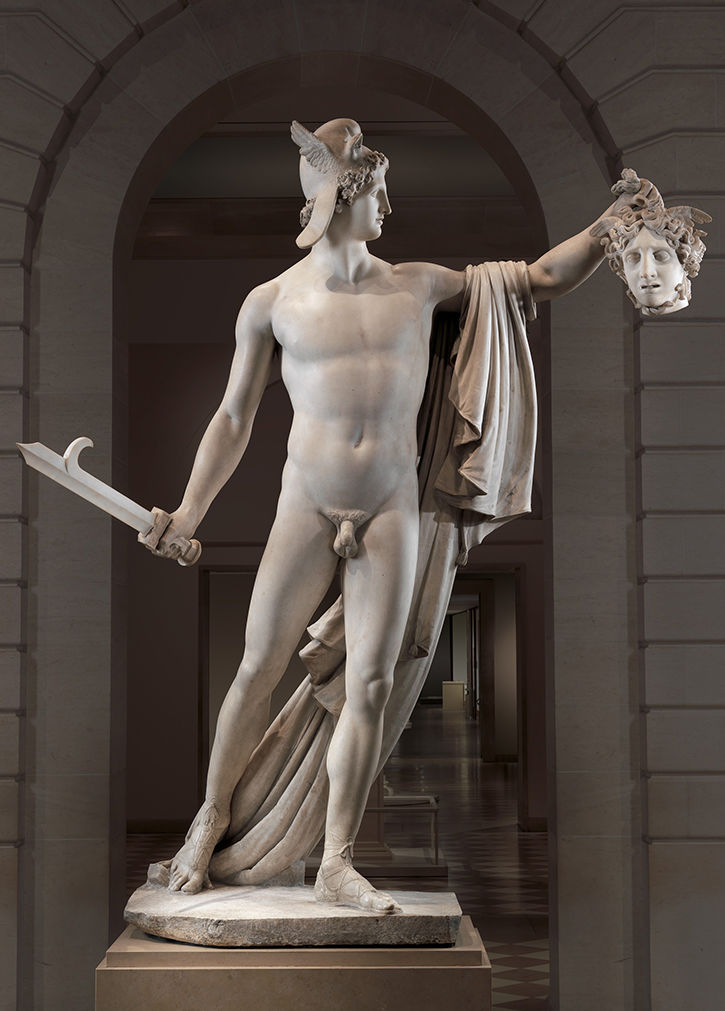
       [ THE KINETIC STALEMATE ]

         Forward Intent (Upper Body / Weapon)
               --->      --->
        =================================
                     |  |
                     |  |  <-- Right Leg: Recoil effect
                     /  \
                    /    \ --> Left Leg: Stepping Forward
        =================================
               <---      <---
         Somatic Restraint / Ambient Freeze

         The imagery in its entirety --->Freeze<---
Perseus’s left leg is indeed positioned to step forward, signaling an intentional thrust into a victorious, unburdened future. However, his right leg remains heavily anchored, pulling his weight backward in a gesture of somatic recoil. His lower anatomy is trapped in a kinetic stalemate, caught between the desire to advance and an involuntary physical recoil of rewind, creating effect of freeze in totality. This creates visual contradiction; either the forward motion or the backward motion, which one is true motion, remains a debating point.
This maps the idea that impact is completely independent to intent. Canova’s conscious ambition to carve a seamless stride of triumph is short circuited by his own subconscious and the physical laws of balance and weight distribution recorded in the stone. The material reality yields a portrait of ambient freeze.
The argument that the kinetic hesitation observed in Perseus’s lower anatomy, the backward anchoring of the right leg, is simply the mechanical requirement of replicating the contrapposto balance of the Apollo Belvedere is irrelevant to the argument of freeze registered in the material manifestation. As noted, the simultaneous forward and backward movement are perspectives in stalemate condition. It is irrelevant because such reductionism fails to account for the semiotic collapse that occurs when a posture is tethered to new narrative content. While Apollo’s geometry functions because his gaze tracks an arrow into an infinite, unburdened horizon, Canova forces that identical weight distribution to confront a severed, distressed human face. The presence of Medusa’s visible vulnerability, the visible distressed facial expression, fundamentally alters the physics of the stance. The mechanical distribution of weight is transformed into a permanent monument closed circuit of Perseus Medusa imagery, thus creating a contradiction. Unlike Apollo’s geometry, Perseus is caught in two worlds. The stone may copy the sun god, but the overall geometry alters the meaning.
Head of Medusa: Decoupling the Snakes from the Face
To fully map the overall narrative, we must separate the anatomical elements of the severed head held aloft in Perseus’s hand. Art history treats Medusa’s head as a singular, monstrous object, arguing that her agony is merely the righteous defeat of “Vice” by “Virtue.” This allegorical explanation is yet another narration devoid of metrial realism.
A more closeup visual delineation reveals the hidden layered vulnerability, decoupling the processing center from the emotional reality:
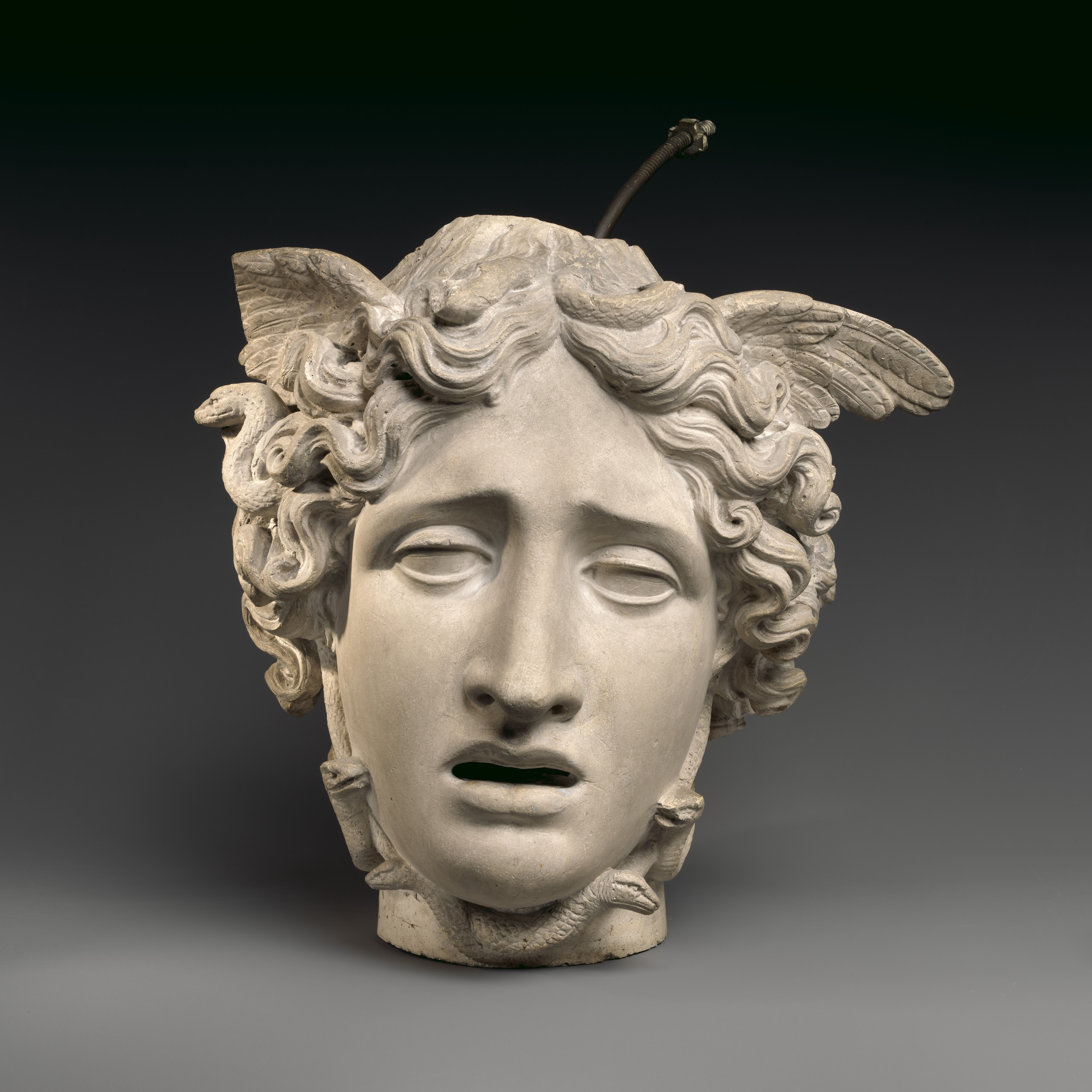
- The Countenance: The human face is carved with anatomical precision, frozen not in monstrous malice, but in raw, innocent distress, vulnerable shock, and profound grief.
- The Narrative: The parasitic, serpentine crown is wrapped tightly around this human countenance.
       [ THE FIREWALL MECHANISM ]

       +------------------------------------+
       |       THE SERPENTINE               |  <-- Culturally coded threat
       |       (The Narrative )             |      (The "Monstrous" Mask Intent)
       +------------------------------------+
                         |
                         v  Harvests & Obscures
       +------------------------------------+
       |       HUMAN COUNTENANCE            |  <-- Raw somatic truth
       |       (Vulnerable Distress)        |      (The visible distress Impact)
       +------------------------------------+
By separating the narrative from the Medusa’s face, the dynamic becomes even further clear. The snakes are not an organic part of Medusa’s identity; they function as a symbolic framework through which the face is traditionally interpreted.
The face of Medusa is visibly in distress while the snakes aren’t in distress. They are merely wrapped over her head without any distinct somatic connection. If they were to be part of her, the dichotomy of face and snake wouldn’t exist. The serpentine crown is the literal architecture of a narrative construction. Symbolically, snakes represent subtext of the entire saga. One interpretation can be, it is a material record of epistemic injustice, taking Medusa’s raw trauma, wrapping it in a fabricated dossier of monstrosity, and displaying the severed face (mind) as a decorative trophy of power to wrongfully deny her credibility and human standing.
Furthermore, the standard Neoclassical mandate of edle Einfalt und stille Größe (noble simplicity and quiet grandeur), which argues that Perseus’s placid expression is merely an artifact of historical style presents another contradiction. If Canova were strictly bound by an absolute rule of emotional suppression, the mandate would apply uniformly. By explicitly rejecting this constraint for Medusa, and rendering her face with anatomical grief while forcing Perseus into icy detachment, the asymetrical application of mandate is observed.
Applying the interpreation, it can also be argued that by denying Medusa noble simplicity, the classical framework historically strips her of dignity to render her a monster, but the raw impact of the carving accidentally grants her a profound psychological reality. Her expressiveness breaks the stone lock and humanizes her, while Perseus’s adherence to the classical ideal makes him appear hollow by comparison.
These contradictions on her face testifies for the narrative collapse. It can also indicate snakes function as a symbolic filter that shapes how the face is perceived, allowing the viewer to dismiss her testimony out of hand.
Analogy Error: The Apollo Belvedere Vector Trap
Another argument extends from the lower anatomy to the historical lineage of the posture as a whole, as Canova was commissioned to sculpt a replacement. The argument that the backward turn of Perseus’s neck and his calm expression are simply the passive side effects of copying a divine prototype yet again presents a contradiction.
Directionally, both Apollo and Perseus turn their heads along the exact same vector (to their left). However, a total semiotic collapse occurs at the end of that line of sight:
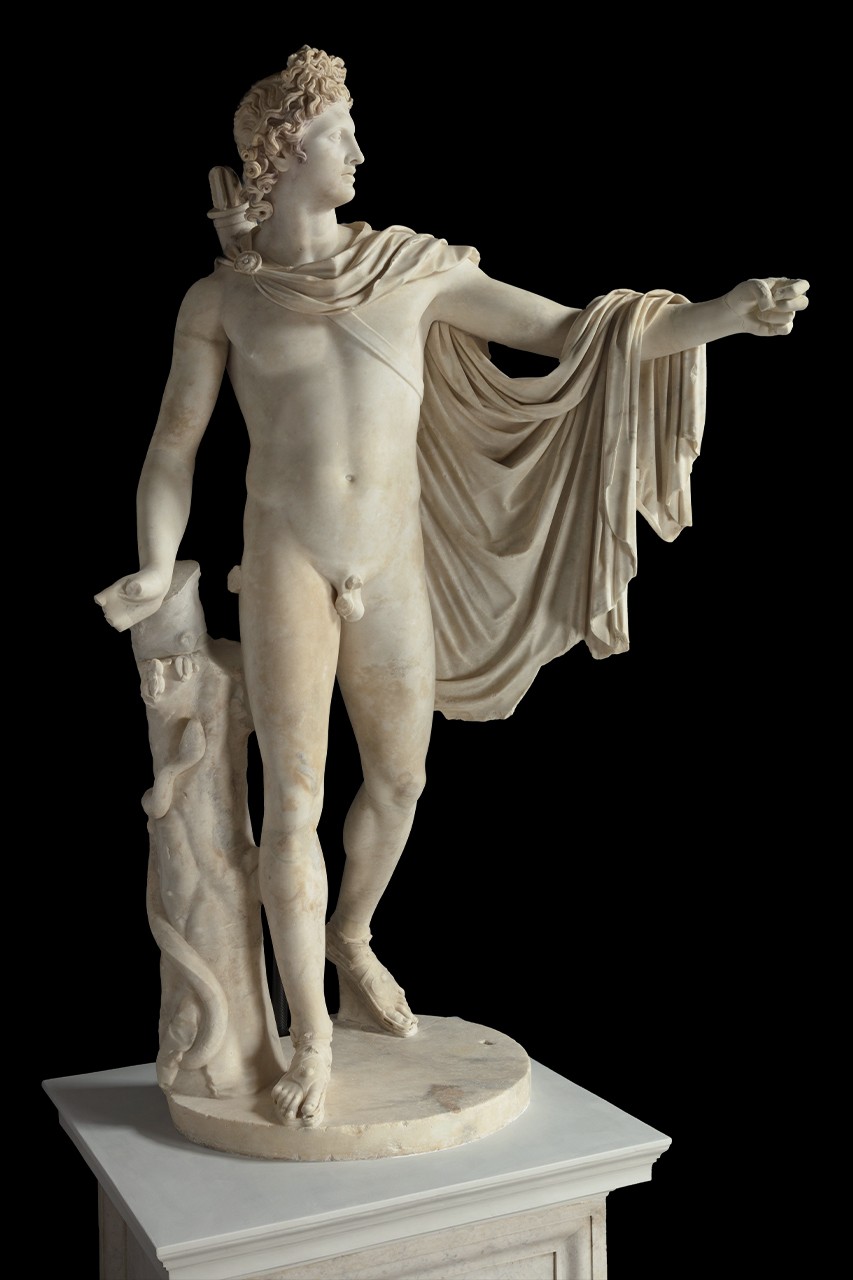
| Statue | Hand Contents | Nature of Gaze | Spatial & Psychological Impact |
|---|---|---|---|
| Apollo Belvedere | Empty Space | Expansive (Open Loop) | Tracks an arrow into an infinite, unburdened horizon. Serene, clean, and detached godhood. |
| Canova’s Perseus | Severed Human Mind | Arrested (Closed Circuit) | Locked directly onto a trophy of raw trauma. Cold, bureaucratic, and trapped executioner. |
Canova’s fidelity to the Apollo prototype produces a brilliant piece of investigation. To force the expansive, serene posture of a sun god onto a man holding the distressed countenance of a severed human face is a profound semiotic collapse. The identical head turn exposes a chilling contrast: Apollo looks at his legacy; Perseus is permanently caught in the dichotomy of two worlds. The entire composition of Perseus and Medusa locks them together in a closed circuit. The composition continually reconnects Perseus to the object he displays, even if he tries to look away like Apollo, his hand forces the viewer to connect the two faces permanently. He wears an unbothered expression while holding the severed head (mind) of someone whose distress has been visually restored by the chisel, challenging the “hero” narrative to match with the physical geometry of sculpture.
Perseus physically averts his eyes (attempting to escape into Apollo’s infinite horizon), but the viewer’s eye is forced into a closed circuit between the two faces. Perseus’s diverted gaze introduces a visual tension between attention and avoidance that becomes difficult to ignore once noticed.
Myth of Medusa: The Temporal Arrest
This geometric trap brings the synthesis to its final argument, the composition produces a form of temporal arrest within the heroic narrative itself.
In the original myth, Medusa’s gaze turned living men to stone. In Canova’s marble, her carved distress achieves the exact same result. Perseus’s attempt to use the stolen, divine geometry of Apollo to present his victory in an unburdened future is frozen. His line of sight is directionally tethered to her distressed face when looked at in its entirety, and his progression is locked by a temporal arrest.
                  [ THE TEMPORAL TRAP ]

   Perseus (Attempts Progression) -------> [Future Victory]
     ^                                         |
     |                                         | Denied / Blocked
     | Directional Gaze                        v
     +---------------------------------- Medusa's Countenance
                                         (Permanent Stone-Lock)
He cannot dissocoiate from the impact. He can never sheathe his sword, he cannot lower his arm, he cannot relax like Apollo, and he can never turn to face the front to claim the adulation of the gallery. In myth, Medusa turned men to stone; here, her carved distress stone-locks Perseus’s supposed victory. She strips the Perseus of his progression, forcing him to stand as a permanent monument caught in dichotomy, tethered to herself, and forever denied the clean horizon he tried to claim.
Conclusion: The Resolution
Ultimately, this cultural and architectural delineation scales upward from an evaluation of stone into a universal law of human interaction with art. It maps out the devastating impact of how minds percieves art through narrative.
When harm is committed, accepted, and corrected, the correction in the narrative allows reality to remain intact, and semiotic reconciliation becomes possible because the truth is preserved, and meanings are merged.
But when harm is committed without acceptance, the undercurrent refuses the merging and semiotic collapse never happens, leading to wobbling and forever narrative construction.